

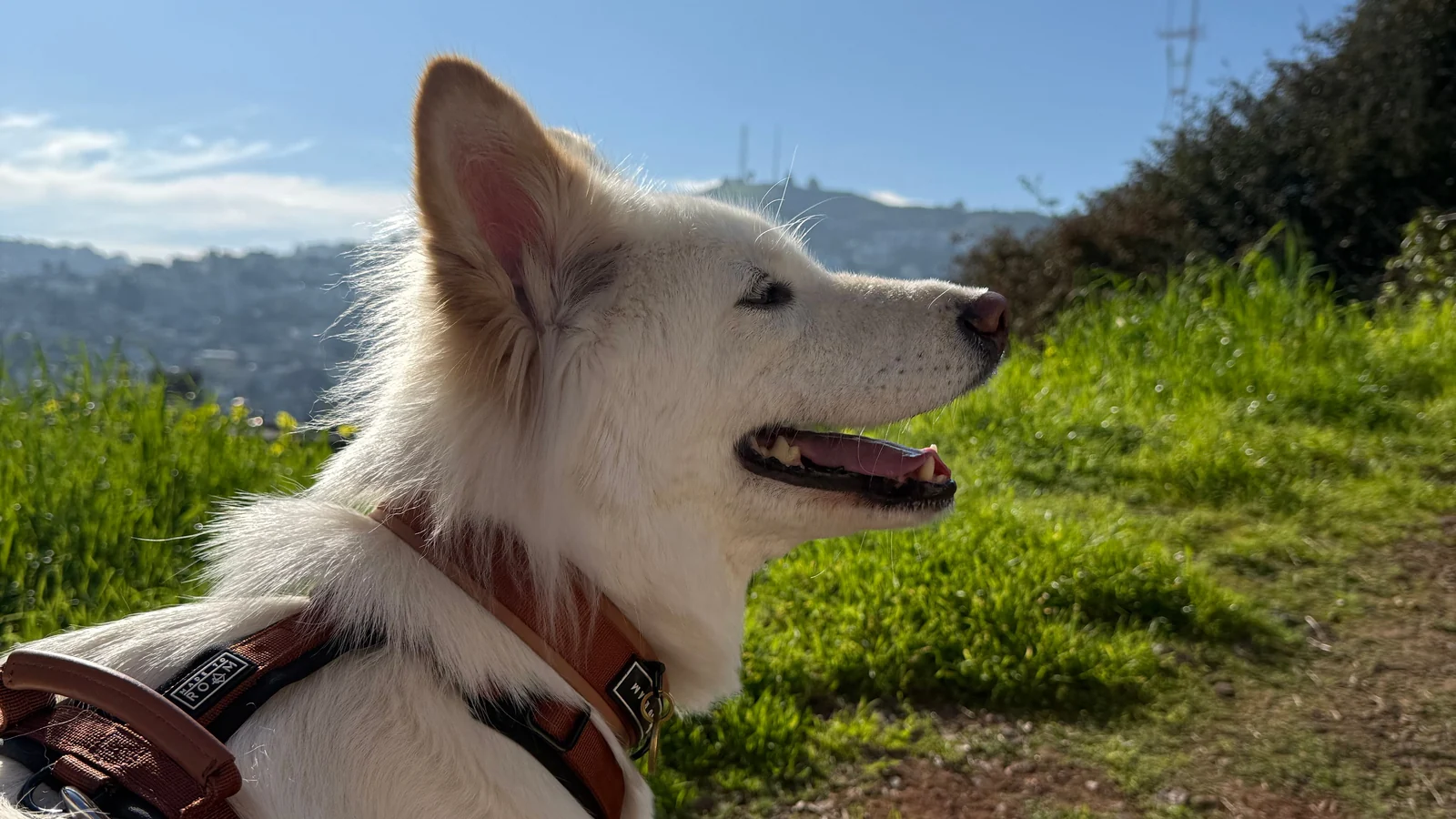
Some walks get measured by the number of blocks covered. A sniff walk starts with a different question: where can your dog explore comfortably while you keep the outing manageable?
You do not need to travel anywhere special to make room for sniffing. A familiar route in Cole Valley, Noe Valley, or the Castro can work if you choose appropriate places to pause and stay aware of everyone else using the sidewalk.
Choose the Space Before Choosing the Distance
Think about width, visibility, traffic, and room to move away from other dogs. A broad path with a clear view ahead may suit your dog better than a narrow stretch beside parked cars, even if the narrow route is quieter on a map.
Look for public space where a pause does not block a doorway, bus stop, curb ramp, or pedestrian route. Planted areas and private gardens are best left to admire from the sidewalk. Your dog’s interest in a spot is a great sign, and a spot that works for everyone nearby is even better.
Start with one or two comfortable locations on a route you already know. That makes it easier to pay attention to your dog instead of trying to navigate and assess a new neighborhood at the same time.
Make the Pause Understandable
Give your dog room to investigate within the reach of the leash, while keeping the leash from stretching across another person’s path. Move with the dog when there is safe space to do so. You do not have to stand still at the end of a tight leash and wait for the dog to finish.
When it is time to move on, use a familiar cue (a word or signal your dog knows, like ‘let’s go’) and a small treat that suits your dog’s diet. Practice that transition in easy places before you need it at a crowded corner. The American Veterinary Society of Animal Behavior recommends reward-based training, and that is the approach we use for every skill on a walk.
If moving away from a scent becomes a repeated struggle, treat it as a skill to practice together. Our loose-leash walking guide explains the skills that support a more comfortable walk.
Keep the Surroundings in View
A dog looking down at an interesting scent may not be monitoring an approaching skateboard or another dog. You still need to scan ahead and keep an eye on the space around you. Move away early when a route is getting crowded rather than waiting until everyone is close together.
Your dog can explore a scent without meeting the dog nearby. If more space feels right, try a wider arc, another block, or an earlier turn home.
The same applies to a dog who suddenly seems reluctant to investigate. A quiet walk can change quickly when deliveries arrive or construction starts. Adjust the route to what is happening today rather than asking the dog to reproduce yesterday’s outing.
Sniffing Plus the Everyday Basics
A sniff walk still includes bathroom opportunities, safe movement, water planning, and attention to physical comfort. It is not a formula for replacing all exercise with a fixed number of minutes spent smelling a tree.
Different dogs need different activity plans. If your dog has health restrictions, is recovering from an injury, or shows a new change in stamina, ask your veterinarian about the appropriate outing. Our exercise guide can help you organize the questions without assuming one duration fits every dog.
Keep notes about practical patterns. Which route gives enough room? Where does the dog seem comfortable pausing? Which corner repeatedly makes it difficult to move on? Those observations will tell you a lot about what works for your dog.
Share the Route With Your Walker
If a professional walker is part of the routine, explain where your dog enjoys exploring and how you ask them to continue. Share the places you avoid as well. A good handoff includes both the route and the reason behind it.
Sniff and Go’s private, on-leash dog walking makes space to adapt the outing to one dog’s pace and needs. Our BetteR+ Dog Walks or Good Dog Walks build in time for dogs to sniff and explore at their own pace. For familiar local starting points, see our service information for Cole Valley and Noe Valley.
Tell us about your dog’s walks if you want help building a routine with room to explore. The useful measure is whether the outing works for your dog and the city around you, not whether you checked off the longest route.