

"Is one 30-minute walk a day enough?" is a question we hear from new clients constantly, usually alongside "is that too much?" and "how do I know if she's getting enough?"
The answer is almost never about how much, it is usually about what kind. A dog can walk five miles a day and still chew the couch. Another dog can finish a 30-minute walk and sleep soundly for the rest of the afternoon. The difference usually isn't distance. It's what happened on that walk.
We have been doing this in San Francisco for over seventeen years, and the honest takeaway is that every dog is different. What follows is how we think about it.
The principle that changes everything
Mental enrichment tires dogs faster than physical movement alone.
Think about the last time you sat through an hour-long math class or a long work meeting. You weren't running. You weren't lifting anything. But by the end you were genuinely tired, because your brain was processing the whole time. Or think about driving four hours. You are not exercising, but you are making constant small decisions, tracking other cars, reading the road, and by the time you arrive you feel it.
Dogs experience something similar, except the ratio is compressed. Roughly ten minutes of active mental engagement for a dog is comparable to an hour of that kind of mental processing for a person. That is not a small thing. It is the entire reason a thoughtful 30-minute walk can produce a calmer, more settled dog than an hour of covering ground at a steady pace.
This is the idea behind BetteR+® Dog Walks, our signature service at Sniff and Go. Every walk cycles through three components, over and over, for the full duration.
What a BetteR+® Dog Walk actually looks like
Every BetteR+® Dog Walk cycles through three components throughout the duration of the walk: Walk Games, Decompression, and Loose Leash Walking skills.
Walk Games are short mental enrichment intervals woven into the walk. They give your dog's brain something to engage with while they are out in the world, and that engagement is where a lot of the real tiredness comes from.
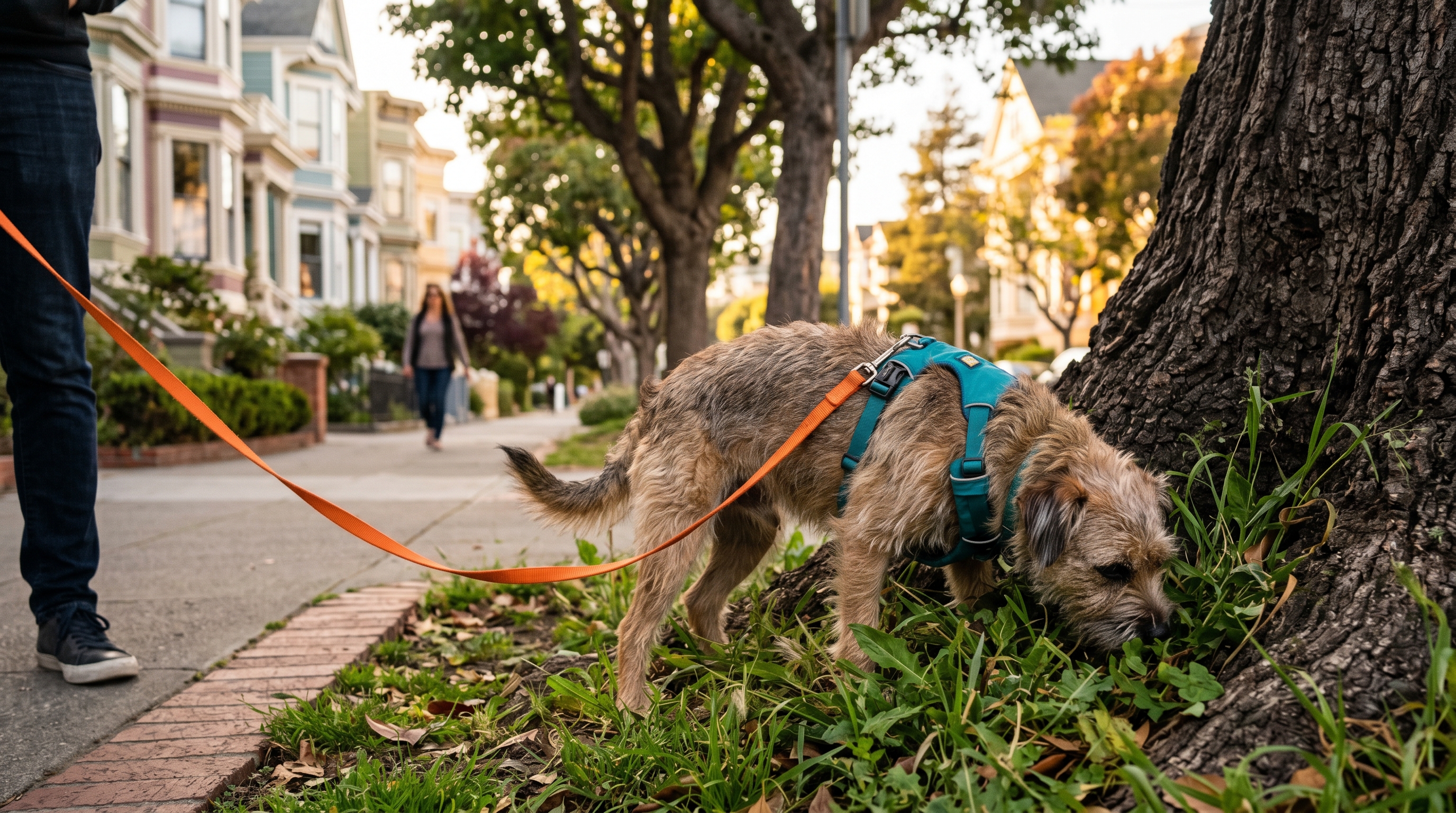
Decompression is unstructured sniff time, where your dog gets to move at their own pace and just be a dog. It is not a pause in the walk. It is part of what makes the walk work.
Loose Leash Walking ties the movement together, helping your dog cover ground comfortably while still getting the physical exercise that comes with moving through the city.
How those three things are layered and rotated is where the work happens, and that part we have spent a long time getting right.
A rough guide by size (loose guidelines only)
Every dog is different, and there are enough variables at play that we want to be upfront: these are starting points, not prescriptions. Age, health, individual temperament, and what kind of walk it is all matter more than breed alone. That said, for healthy adult dogs, here is a general range for total active outdoor time per walk.
- Toy breeds (chihuahua, pomeranian, yorkie, papillon): 15 to 30 minutes. San Francisco hills count for more than people expect with smaller dogs.
- Small breeds (cavalier, frenchie, boston terrier, pug): 15 to 45 minutes. Flat-faced breeds need paced, shaded routes and do not do well in heat.
- Medium breeds (cocker spaniel, beagle, mini schnauzer): 30 to 60 minutes. Scent-driven dogs especially benefit from decompression time.
- Senior dogs (roughly age 8 and up): a potty break to 30 minutes, depending on the dog. Frequency often matters more than duration at this stage. Watch for stiffness the next morning.
- Puppies under 6 months: potty breaks to 30 minutes, every two to three hours depending on age. Keep it gentle. Avoid stairs, jumping, and long downhill stretches until growth plates close.
What enrichment looks like on a walk
A walk is not a stopwatch. It is a series of opportunities to use your dog's brain. A well-rounded outing usually includes some intentional loose-leash walking to settle the dog, a stretch of decompression sniffing where they get to lead the pace, a little light training, and some brisker movement to cover ground. The proportions shift depending on the dog and the day.
The total steps from a walk like that are often lower than a fast walk would produce. The dog is more tired after, more settled the rest of the day, and happier on the next outing. That is the trade we make on every BetteR+ session, and it is why the structure matters as much as the duration.
A last thing
The dogs in San Francisco who do best are not necessarily the ones getting the longest walks or the biggest weekend adventures. They are the ones with a predictable daily rhythm and walks that give their brain something to do. If you can build that pattern, with or without help, almost any breed can be a calm and happy city dog.
If you are curious what a BetteR+ Dog Walk or any of our walk options could look like for your dog, we are happy to talk through it. That is what we are here for.
Common questions
How much exercise does a dog actually need per day?
Most adult dogs need somewhere between 15 and 60 minutes of active outdoor time per day, depending on size, age, and individual energy. For city dogs, quality tends to matter more than quantity. A walk that includes sniff time, light training, and varied engagement will tire most dogs more than a longer walk at a steady pace with nothing to process.
Is one 30-minute walk a day enough?
For some dogs yes, for many it depends on what that walk includes. A 30-minute BetteR+® Dog Walk with mental enrichment woven throughout will do more for your dog than a 30-minute walk that is just movement. If your dog seems restless or is showing signs of under-exercise, the first question worth asking is what kind of walk they are getting, not just how long.
Can you over-exercise a dog?
Yes, especially with puppies and senior dogs. Repetitive high-impact activity before growth plates close can cause lasting joint damage. Adult dogs can over-exercise too, usually showing up as next-day soreness, behavioral irritability, or reluctance to go out. Mental enrichment, like sniffing and light training, does not carry the same risk and is often more valuable anyway.
Does mental exercise really count?
More than most people expect. A 20-minute walk where your dog gets to sniff, problem-solve, and engage with their environment is more tiring than a 40-minute walk where they are just pulled past everything. Decompression sniffing in particular has measurable effects on a dog's stress levels. If you want a calmer dog at home, letting them use their nose on the walk is one of the most reliable ways to get there.
What if I work full-time and my dog is alone all day?
This is the most common situation we see in San Francisco, and one that is easy to underestimate. A dog left alone for nine or ten hours without a midday outlet will find their own enrichment, usually in ways that are frustrating for everyone. A midday private walk, a half-day at a small daycare, or a reliable dog walker can make a significant difference. It is exactly the kind of situation BetteR+® Dog Walks was built for, and we are glad to help figure out what makes sense for your dog and your schedule.
How Sniff and Go can help
Walks built around what actually tires a city dog.
Our BetteR+® Dog Walks are private and one-on-one, and every one cycles through walk games, decompression sniffing, and loose leash work for the full duration. Not a quick lap around the block, a walk built around what your dog actually needs in the middle of a long day.
See How BetteR+ Walks Work →