

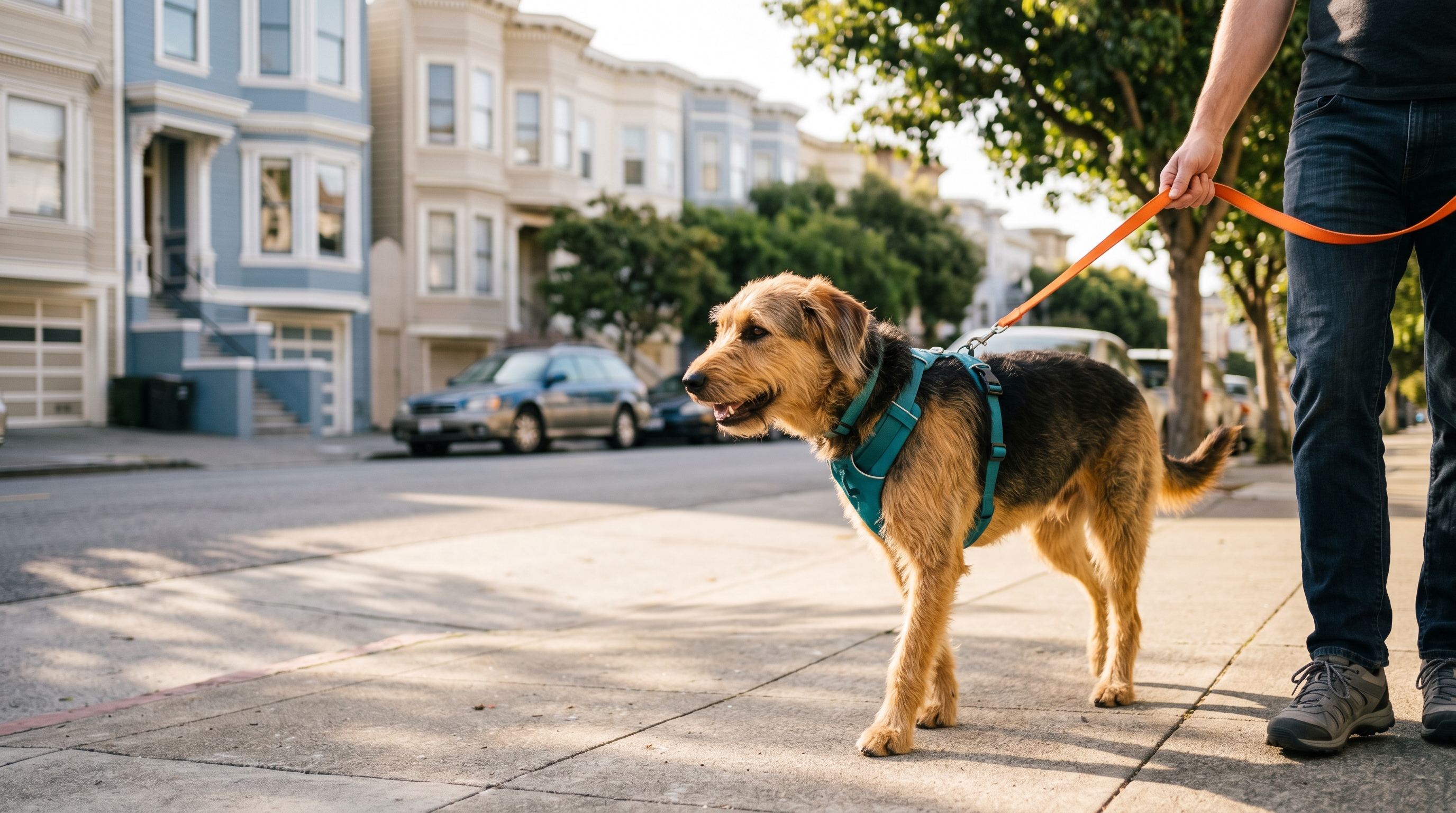
Last week on 24th Street, a woman watched her doodle lose it at another dog across the road. Barking, lunging, hackles up, the full performance. She caught our eye, mouthed "I'm so sorry," and physically deflated. She wasn't apologizing for the noise. She was apologizing because we, the dog people, were watching her dog be what she thought was a bad dog.
Her dog isn't bad. He's reactive. Those are not the same thing, and the difference is probably the single most important thing she could learn about her own dog right now.
Sniff and Go has been doing private, one-on-one dog walks in San Francisco since 2009, and over the years reactive dogs have become a meaningful part of who we serve. That's given us a front-row seat to what's actually happening with these dogs, what their owners have already tried, and where a lot of the well-meaning advice tends to miss the mark.
What "reactive" can look like
A reactive dog has a response to a trigger that's bigger than the situation calls for. Another dog. A skateboard. A person in a hat. A bike. A delivery driver. The response might be barking, lunging, freezing, or fixating. It might look dramatic or it might be subtle. What they have in common is that the dog is over threshold for what's actually in front of them.
Reactivity tells you about a dog's threshold, not their character. It's a stress response. Most of the reactive dogs we walk would be terrified to actually engage with the thing they're barking at. The bluff is the entire strategy. Loud display, body forward, mouth open, and what they want more than anything is for the trigger to be further away than it is. Barking and lunging at a passing pug from across the street isn't aggression. Often, it's just bad coping.
Reactive vs. aggressive: where the confusion lives
Aggression is the intent to do harm. Reactivity is a stress response that looks scary. From the outside, the behaviors overlap. From the inside, the motivation is completely different.
The way we think about it: reactivity is usually a dog trying to make something uncomfortable go away before it gets worse.
Reactive dogs can become aggressive if they're cornered, punished for the reactivity, or pushed past their threshold over and over again. That is exactly why getting this right early matters. A reactive dog who is repeatedly placed in situations they can't escape often learns to escalate, because the bluff stopped working and they had to find something that did.
San Francisco is a reactivity factory. We say that with love.
SF sidewalks are four feet wide, if we are lucky. You cannot create distance from a trigger when there is no distance to create. Your dog sees another dog thirty feet away, freezes, and you're stuck. Parked cars on one side, buildings on the other, another dog starts walking up the back side of the street... trigger keeps coming.
Add the rest of the variables:
- Off-leash dogs from owners who think their dog is the exception
- E-scooters that appear from nowhere at fifteen miles per hour
- Construction sites that close sidewalks for months at a time
- Tour buses, MUNI brakes, idling garbage trucks
- One of the highest dog-to-human ratios of any city in the country
- The wind tunnel between the buildings on Market that flips a trash can over right next to your dog
- and more!
Your dog isn't broken. They're trying to function in an environment that was not built for them. A reactive doodle in a quiet Connecticut suburb is a different animal than the same doodle on Castro Street at 8:30 in the morning.
Five things most owners get wrong
1. "He's just being protective."
He might be stressed, overstimulated, or guarding something he values. 'Protective' is a label that can mean a lot of different things, and it's worth understanding which one is actually happening with your dog, because the approach looks different depending on the answer.
2. "He'll grow out of it."
Sometimes. Usually not, and rarely without help. Reactivity gets worse with rehearsal. Every time your dog practices the bark-and-lunge routine and the trigger eventually goes away (which it always does, because you keep walking), they learn that the strategy works. Six months of unaddressed leash reactivity is six months of training a dog to bark at things.
3. "More socialization will fix it."
Often it makes things worse. Throwing a reactive dog into a busy dog park is like sending someone with severe social anxiety to a wedding to "get over it." The exposure isn't the medicine. Carefully managed exposure with positive associations is the medicine. There is a real distinction between socialization (good for puppies, with structure) and flooding (bad for anyone).
4. "He just needs to meet more dogs."
On-leash greetings between strange dogs are a structural problem before they're a behavior problem. Two dogs, restrained, face to face, unable to move freely away from each other. Even well-adjusted dogs read that as tense. For a reactive dog, it's a setup designed to fail. The greeting goes badly, both owners are now stressed, and the dog has just rehearsed another reactive episode.
5. "A trainer with an e-collar will fix him fast."
Aversive tools can suppress the visible behavior. They do not change the underlying feeling. You end up with a quieter dog who still feels exactly the same about the trigger, plus a new layer of stress about getting corrected. The reactivity often comes back, often worse, and now your dog also doesn't fully trust you near the trigger. We have rehabbed enough dogs who went through this pipeline to be very clear about it.
What actually helps
The short version: stop putting your dog in situations where they have to react, and start changing how they feel about the trigger when you can manage the distance.
The longer version is a list:
- Distance is free. Cross the street. Tuck behind a parked SUV. Turn around and walk the other way. There is no rule that says you have to pass the trigger.
- Know your dog's threshold signals. Ears locked forward, hard stare, mouth shut tight, body stiff, tail high. You have about three seconds from the time you see those signs to add distance before the explosion. Once they go over, the walk is about recovery, not training.
- Pair triggers with food. Not as a bribe. As a slow rewiring. Trigger appears at a manageable distance. Your dog notices. You feed. Trigger goes away. Repeat for weeks. You are teaching your dog that other dogs predict good things, not pressure.
- Use management tools that don't add stress. A front-clip harness, a five or six foot leash you can actually steer with, and a treat pouch worn outside your jacket so you can deliver food fast. No flexi-leashes near triggers. No prong collars.
- Stop apologizing. People expect well-behaved dogs to be silent dogs. Reactive dogs are usually well-behaved 95% of the time and the public only sees the 5%. You don't owe a stranger an explanation, and the apology habit keeps you in a defensive crouch that your dog reads.
- Get help from someone qualified. A CPDT-KA, IAABC, or KPA-CTP credentialed trainer who explicitly works force-free with reactive dogs. Not a board-and-train. Not someone whose Instagram is shock collars on dogs. Not someone who promises a fix in a weekend.
Why private walks are part of the protocol
This is the part where we tell you what we do, so we'll keep it short.
We started doing private, on-leash, one-dog-at-a-time walks in 2009 because we kept seeing the same pattern. Reactive dogs were getting worse on group walks. They were stuck in close proximity to other dogs for forty-five minutes at a stretch, with no way to add distance, no way to opt out, and a handler who was managing four other leashes and couldn't catch the early threshold signals on any one of them.
A private walk gives a reactive dog the things they actually need. Space when they need it. A handler whose only job is reading this dog. No surprise dogs in their face. A consistent route the dog already knows, with the trigger zones pre-mapped. Daily notes that flag what worked and what didn't, so the next walk builds on the last one.
Most of our reactive clients show noticeably fewer reactive behaviors over time in our care. Not because we fixed them. Because the environment we put them in is one where they don't have to be.
A last thing
Reactivity is one of the most misunderstood patterns in pet dogs. It looks like aggression, gets treated like aggression, and the dog ends up either suppressed by aversive tools or surrendered because the owner ran out of options.
Your dog isn't bad. They're not broken. They don't need to be sent away to a three-week board and train to come back fixed. They need someone who understands what's actually happening and an environment that lets them not have to perform that behavior every single day. If you live in San Francisco and your dog is reactive, you're in the right city to find that help, and you're not alone.
Reactive dogs in SF: common questions
What is a reactive dog?
A reactive dog has an outsized response to a specific trigger, like another dog, a skateboard, a bike, or a stranger in a hat. They bark, lunge, freeze, or fixate at a level that's bigger than the situation calls for. Reactivity is a stress response, not aggression. Most reactive dogs are trying to create distance from something that overwhelms them, not start a fight.
Is a reactive dog the same as an aggressive dog?
No. Aggression is the intent to do harm. Reactivity is a stress response that often looks like aggression from the outside. The behaviors overlap visually, but the motivation is different. Reactive dogs typically want the trigger to go away. Aggressive dogs want to engage with it. That distinction matters because the training approaches are completely different.
Can a reactive dog be trained out of it?
Yes. Reactivity is one of the most trainable behavior patterns in pet dogs when you address it with positive reinforcement and a thoughtful exposure plan. The goal is not to cure the dog. It is to change the underlying emotional response to the trigger by pairing the trigger with good things at a manageable distance, then slowly closing that distance over weeks and months.
Why are reactive dogs harder to manage in San Francisco?
San Francisco has narrow sidewalks, high dog density, off-leash dogs whose owners think their dog is the exception, e-scooters, parked tour buses, and construction zones that block pedestrian paths for months. You often cannot add distance from a trigger because there is no distance to add. The city is structurally hard on reactive dogs.
Should I take my reactive dog to a dog park?
Usually not. Dog parks are uncontrolled environments where you cannot manage your dog's distance from triggers or screen for other dogs' behavior. For most reactive dogs, the dog park is the worst possible kind of exposure. Controlled introductions, parallel walks with calm dogs, and quiet open spaces are better starting points.
How Sniff and Go can help
Reactive dogs are most of what we walk.
Our BetteR+ walks are private and on-leash by design, which gives a reactive dog the one thing they actually need: control over distance. Your dog gets a handler whose whole job on the walk is reading your dog, on consistent routes with pre-mapped trigger zones, and daily notes about what worked.
See How BetteR+ Walks Work →